

EAGLE III's mission is to maximize health outcomes by providing high-quality, compassionate patient care and safe, rapid medical transportation.
EAGLE III Landing Zone Preparation
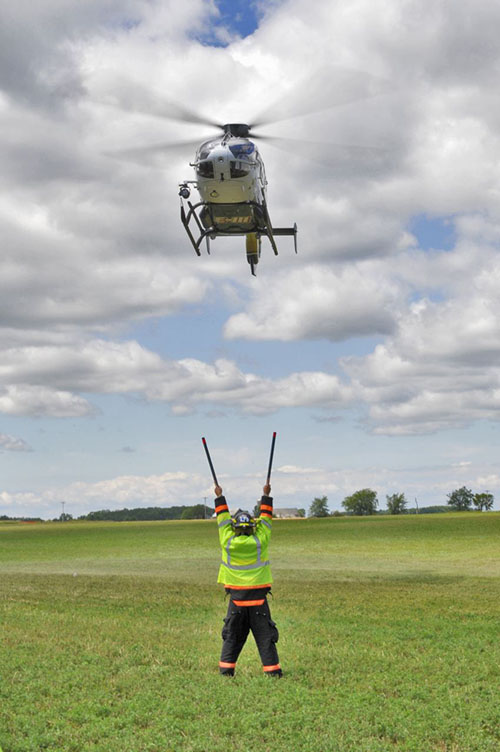
To land at a site other than an approved helipad, ground personnel should be available to assist in selecting and securing a landing area. All landing areas must be lighted after dark. Emergency vehicles with rotating beacons can aid the helicopter in locating the landing area at night. A safe landing zone can be prepared by using the following guidelines:
- Should be level, firm, and free of loose debris
- The landing zone should be at least 60’x 60′ in daytime/good visibility or at least 100′ x 100′ in nighttime/reduced visibility
- Clear the landing zone of people, vehicles, and any other obstructions such as trees, poles, wires, large rocks, and high grass
- Remember that wires are difficult to see from the air and the crew should be notified of any in the area
- Keep spectators and emergency vehicles back at least 200 feet and have fire equipment standing by
- If eye protection is available, ensure that it is in place during landings and take-offs
- Please remove all hats and if helmets are worn, chin straps must be securely fastened
If the landing zone is extremely dusty, it should be wet down by firefighters (if available) Crew should be prepared to communicate to the pilot the following information:
- Wind direction
- Touchdown Area information; DAY: communicate with the ground personnel for area location and hazards. NIGHT: Landing Zone should be illuminated by either red chemical lights, red strobe lights or vehicle headlights.
EAGLE III also is willing to train members of your department as Landing Zone Specialists. These services are available upon request at no cost.
“The entire crew was wonderful! I knew my son was in excellent care!”